How Long Is a Football Field?
Those three numbers answer the question for almost everyone who asks it. The rest of this guide explains why there is a range rather than a single size, gives every key marking, and works out the two conversions people search for most: football fields per acre, and football fields per mile.
Key facts
| Fact | Detail |
|---|---|
| Senior internationals | 100-110 m long (110-120 yards), 64-75 m wide (70-80 yards) |
| Standard pro size | 105 m × 68 m (115 × 74 yards), recommended by FIFA |
| Goals | 7.32 m wide × 2.44 m high (24 ft × 8 ft), fixed at every level |
| Penalty spot | 11 m from goal; penalty area 16.5 m out |
| Area | A 105 × 68 m pitch covers 7,140 m², or 1.76 acres (0.57 pitches per acre) |
| Per mile | 15.3 soccer pitches laid end to end |
| Laws | IFAB Law 1, "The Field of Play" |
Why there is no single official length
Football's Laws deliberately allow a range. Law 1, "The Field of Play", written by the IFAB and applied by FIFA, sets the touchline (the length) at 90 to 120 metres and the goal line (the width) at 45 to 90 metres for general adult matches, then narrows that to 100 to 110 metres long and 64 to 75 metres wide for senior internationals. The full Laws are published at theifab.com/laws. A competition may also fix one size inside those ranges: UEFA, for example, expects its top competitions to be played on pitches close to the 105 by 68 metre recommendation.
The range exists because football is played on real grass in real stadiums, many of which were built long before standardisation, and because pitch size is a legitimate part of a club's identity. A narrower pitch suits a team that plays compact, defensive football; a wider one suits a team that stretches play with wingers. Both are legal, and both change how a match feels. What the Laws do fix exactly, with no range at all, are the goals and the key markings, so that scoring and penalties are identical everywhere.
Official dimensions at a glance
| Marking | Size |
|---|---|
| Length, senior internationals | 100–110 m (110–120 yd) |
| Width, senior internationals | 64–75 m (70–80 yd) |
| Length, general adult matches | 90–120 m (100–130 yd) |
| Width, general adult matches | 45–90 m (50–100 yd) |
| Common professional pitch | 105 m × 68 m (115 × 74 yd) |
| Goal, inside of posts | 7.32 m wide (8 yd) |
| Goal, crossbar height | 2.44 m (8 ft) |
| Penalty area, from goal line | 16.5 m (18 yd) |
| Goal area ("six-yard box") | 5.5 m (6 yd) |
| Penalty spot, from goal line | 11 m (12 yd) |
| Centre circle radius | 9.15 m (10 yd) |
| Corner arc radius | 1 m (1 yd) |
One rule ties the whole table together: the pitch must always be rectangular, and the touchlines must be longer than the goal lines. A square pitch is illegal, and so is a pitch wider than it is long. Every line on the field must be the same width, no more than 12 centimetres (5 inches), and all lines belong to the areas they enclose, which is why a ball sitting exactly on the goal line has not fully crossed it.
The markings that matter most
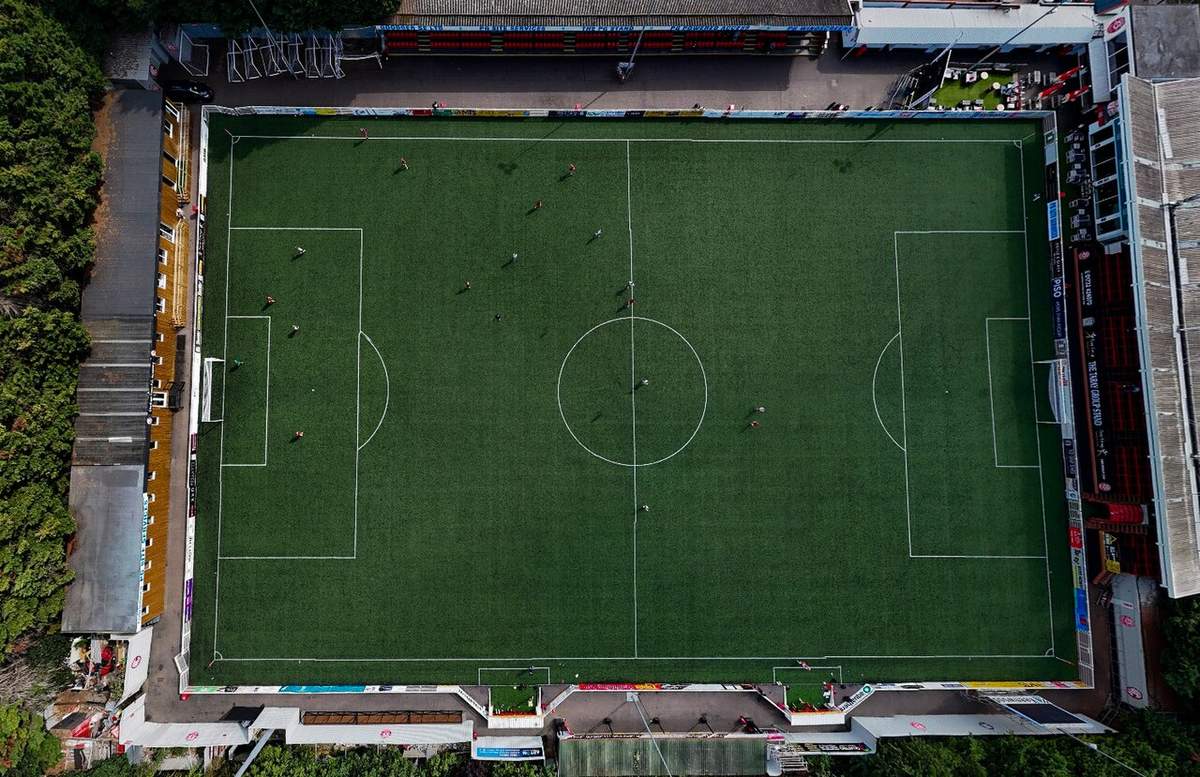
The penalty area extends 16.5 metres out from the goal line and 16.5 metres to each side of the goal. Fouls by defenders inside it are punished with a penalty kick, and goalkeepers may handle the ball inside it. The smaller goal area, 5.5 metres out from the goal, is where goal kicks and certain free kicks are taken from. The penalty spot sits 11 metres from the centre of the goal, and the arc outside the area, the "D", is there to keep other players 9.15 metres from the spot during a penalty, the same distance as the centre circle keeps opponents from kick-off.
The goals never vary: 7.32 metres between the inside of the posts and 2.44 metres from the ground to the underside of the crossbar, at every level of the adult game, from a local league to a World Cup final. When people say a goalkeeper "covers a lot of goal", this is the goal they mean: over seven metres wide and nearly two and a half metres high, guarded by one person.
How big is a football field in feet?
For readers who think in feet, the standard 105 by 68 metre pitch is 344.5 feet long by 223 feet wide. The international range converts to roughly 328 to 361 feet long and 210 to 246 feet wide. The goal is 24 feet wide and 8 feet high. These conversions are approximate because the Laws are written in metric with imperial equivalents, and rounding differs slightly between sources, but for any practical purpose, 345 by 223 feet is the size of a top-level pitch.
How many football fields are in an acre?
This question has two honest answers, because "football field" means two different sports in different countries. Here is the arithmetic, with assumptions stated, so you can check it.
One acre is 4,046.86 square metres. A standard soccer pitch of 105 by 68 metres covers 7,140 square metres, which is 1.76 acres. Turn that around and you get 0.57 soccer pitches per acre: a single acre holds just over half a professional soccer pitch, playing surface only, with no room for stands, run-offs or warm-up areas.
An American football field, including both end zones, measures 120 yards by 53⅓ yards, which is 6,400 square yards or about 5,351 square metres, equal to 1.32 acres. That gives 0.76 American football fields per acre. If you count only the 100 yards between the goal lines and exclude the end zones, the field is 5,333 square yards, about 1.10 acres, or 0.91 fields per acre. Most published answers use the full field including end zones, so 0.76 is the figure to quote, and the difference is worth knowing because it explains why different sources give different numbers.

How many football fields are in a mile?
Again, lay the fields end to end and divide. A mile is 5,280 feet. A standard soccer pitch at 105 metres is 344.5 feet long, so 15.3 soccer pitches fit end to end in a mile. An American football field at 360 feet including end zones gives 14.7 fields per mile, or 14.7 if you round down to whole fields, 14 complete fields with room to spare. Side by side, the numbers are close because both sports settled on a similar playing length, and the small gap between 15.3 and 14.7 is just the difference between 344.5 and 360 feet.
These are fun comparisons, not planning figures. Real stadiums need far more land than the pitch itself: stands, concourses, access roads and safety zones typically multiply the footprint several times over, which is why a stadium site is measured in many acres even though the pitch inside it is under two.
Do youth pitches use the same size?
No, and they should not. Young players play on smaller pitches with smaller goals, scaled to their age and physical development, and the exact sizes are set by national associations rather than by the global Laws. A seven-year-old playing 5-a-side on a pitch a fraction of adult size gets far more touches of the ball than the same child lost on a full-size field, and the game stays enjoyable rather than exhausting. The progression mirrors the team sizes in our guide to how many players are in a football team: 5-a-side, then 7-a-side, then 9-a-side, then the full 11-a-side game on a full-size pitch from the early teens.
The same scaling applies to the ball and the goals. Youth goals are smaller, youth matches are shorter, and none of it is a defect: it is the sport deliberately fitting itself to the players, in the same way the adult Laws fit the adult game.
Artificial turf and hybrid pitches
The Laws allow natural grass, artificial turf, or an approved hybrid of the two, provided the surface is green. Modern hybrid pitches, natural grass reinforced with synthetic fibres, are now standard at top stadiums because they survive far more matches than pure grass. The dimensions do not change with the surface: a 105 by 68 metre pitch is that size whether it is grass, turf or hybrid, and a goal is 7.32 by 2.44 metres on every surface. What changes is maintenance and durability, not geometry.
If you are lining a pitch yourself, for a school or a local club, the practical advice is simple: measure the length first, keep the rectangle honest, put the goals exactly 7.32 metres apart, and mark the penalty spot 11 metres out. Get those four things right and everything else follows from the table above. For the format played on that pitch, see the Spanish-language guide Fútbol 11: qué es y cómo se juega, and for the rule that most confuses spectators, our offside explanation.
Frequently asked questions
How long is a football field in metres?
For senior internationals, 100 to 110 metres. The standard professional pitch is 105 metres long and 68 metres wide.
How long is a football field in yards?
110 to 120 yards long and 70 to 80 yards wide for senior internationals. The common professional size is 115 yards by 74 yards.
How many soccer pitches fit inside one acre?
About 0.57 professional soccer pitches per acre, or 0.76 American football fields per acre including end zones. A soccer pitch covers about 1.76 acres; an American field about 1.32 acres.
How many pitches laid end to end make a mile?
About 15.3 soccer pitches laid end to end, or 14.7 American football fields including end zones.
How big is a football goal?
7.32 metres (8 yards) wide and 2.44 metres (8 feet) high, measured between the inside of the posts and to the underside of the crossbar. This size is the same at every level of the adult game.
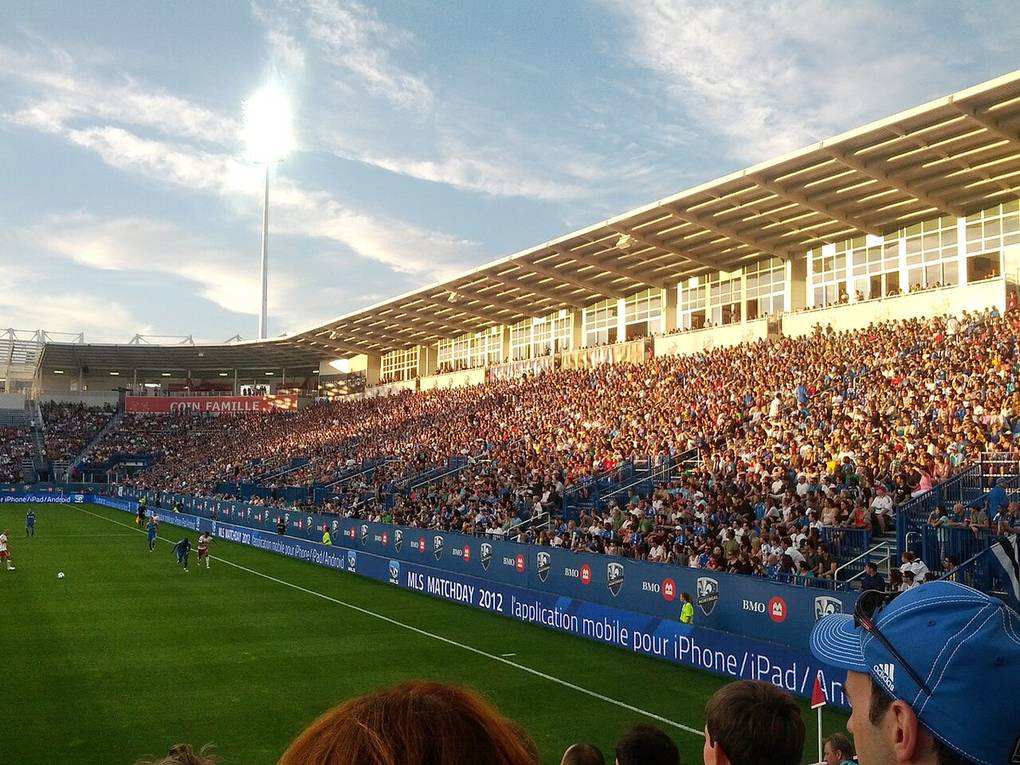
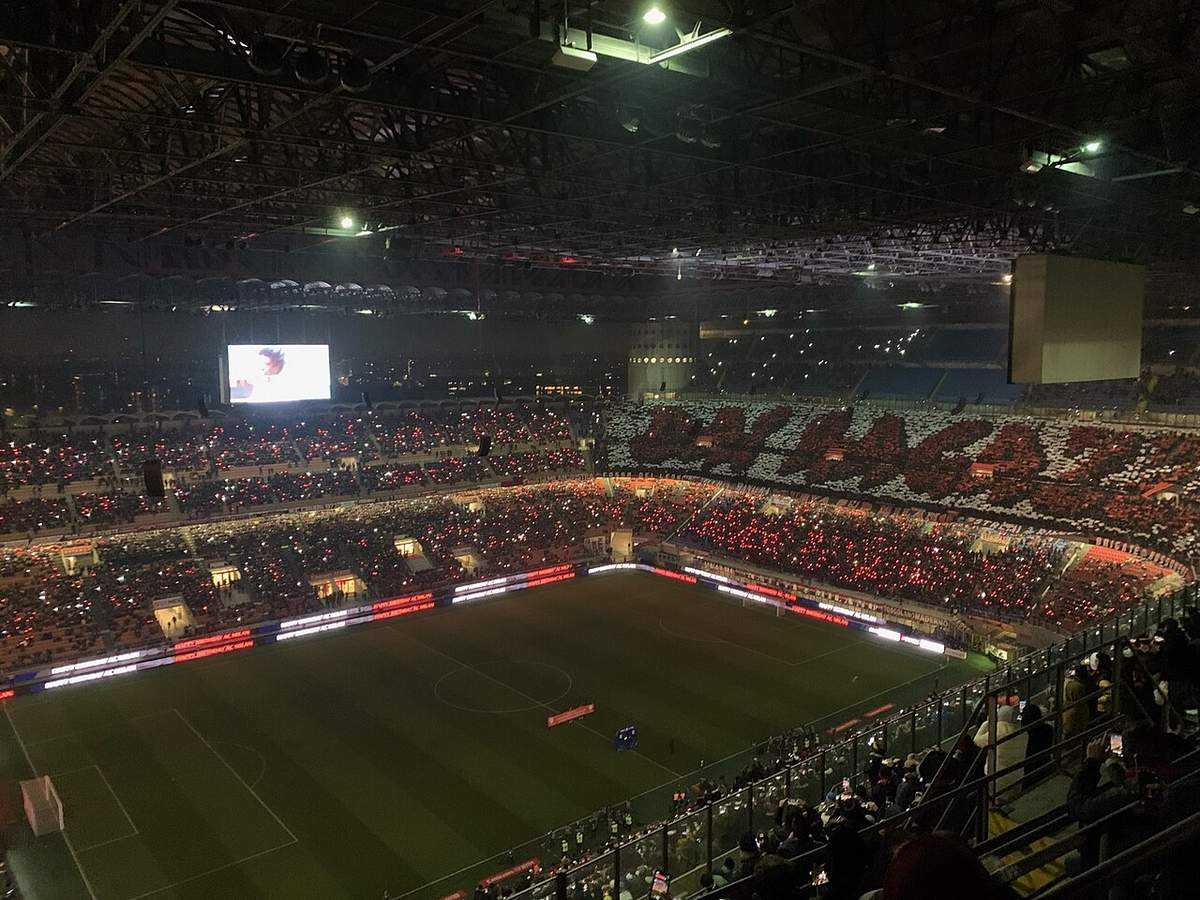
*Photo note: the aerial photograph shows a full-size stadium pitch; the second photograph shows a match in progress. Both are illustrative of pitch dimensions rather than of a specific stadium discussed above. Sources: Wikimedia Commons, CC0 and CC BY-SA 3.0.*